

Long Island City Hunters Point Installation by T. Yorie Corp. Wins National Terrazzo Honor
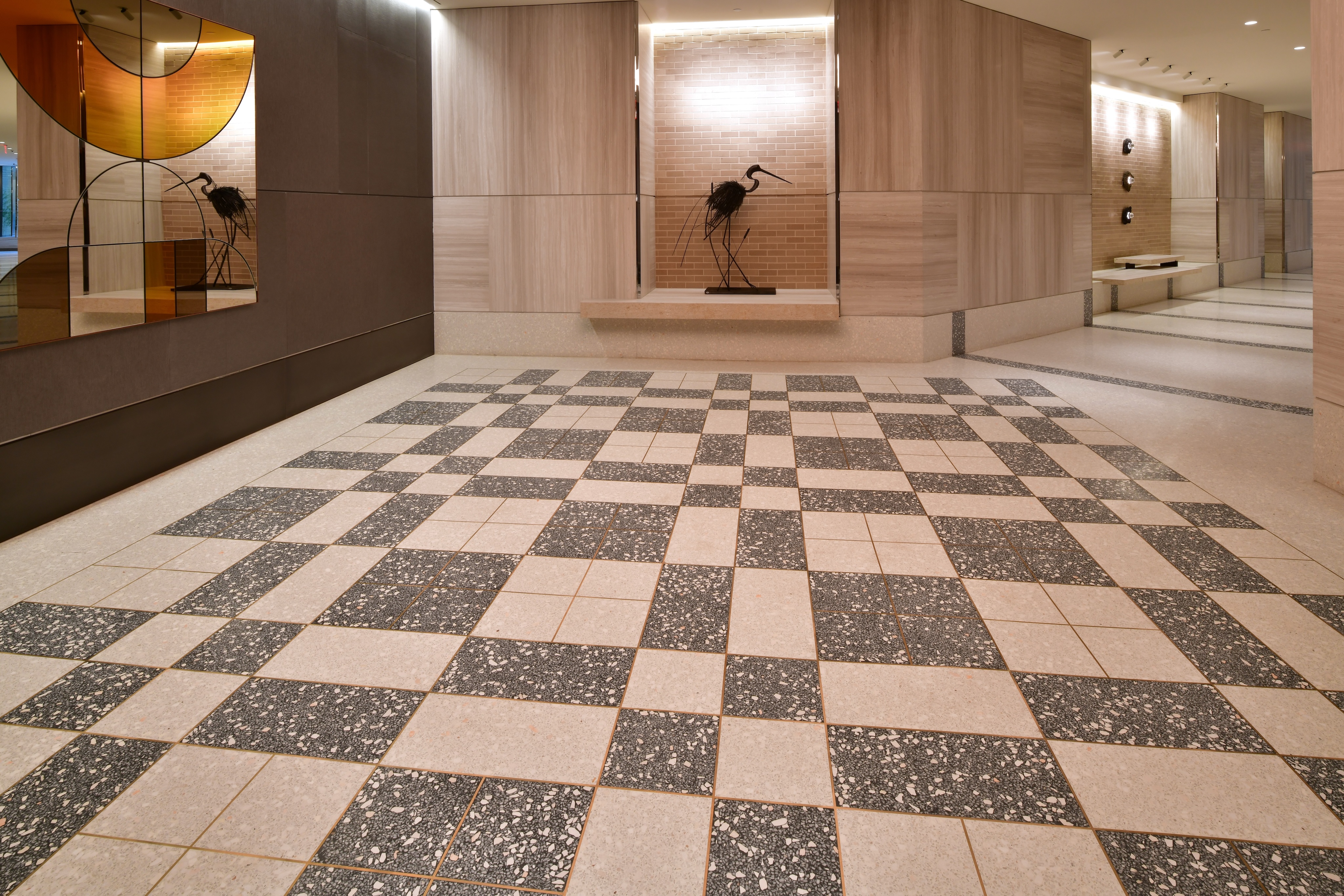
Award-winning epoxy terrazzo lobby floor by T. Yorie Corp. at Hunters Point North in Long Island City, N.Y., was recognized with a 2026 Honor Award from the National Terrazzo & Mosaic Association. © David Laudadio
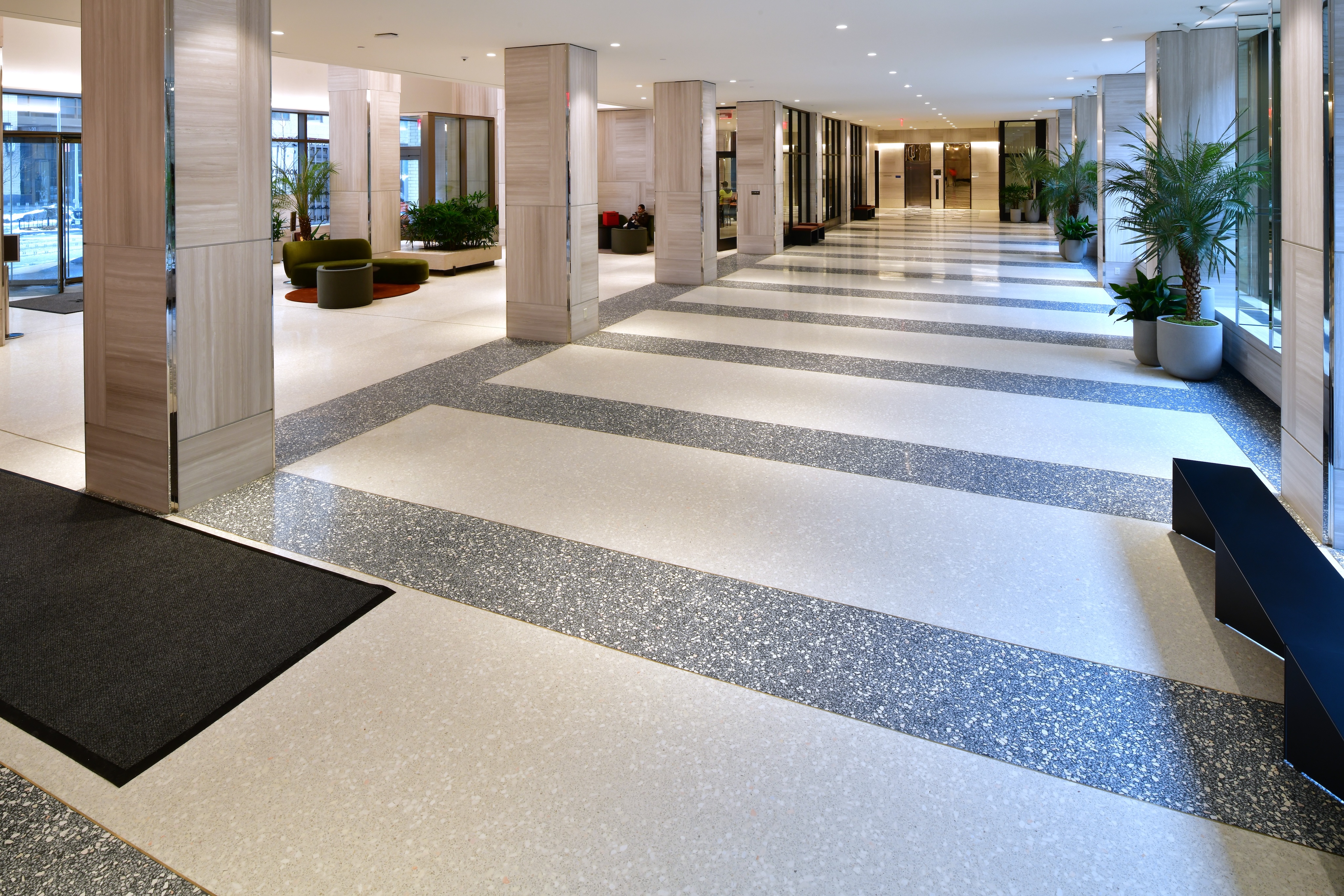
Epoxy terrazzo is installed in the corridor, where measured charcoal bands interrupt a cream field, bringing rhythm and directionality to circulation spaces.
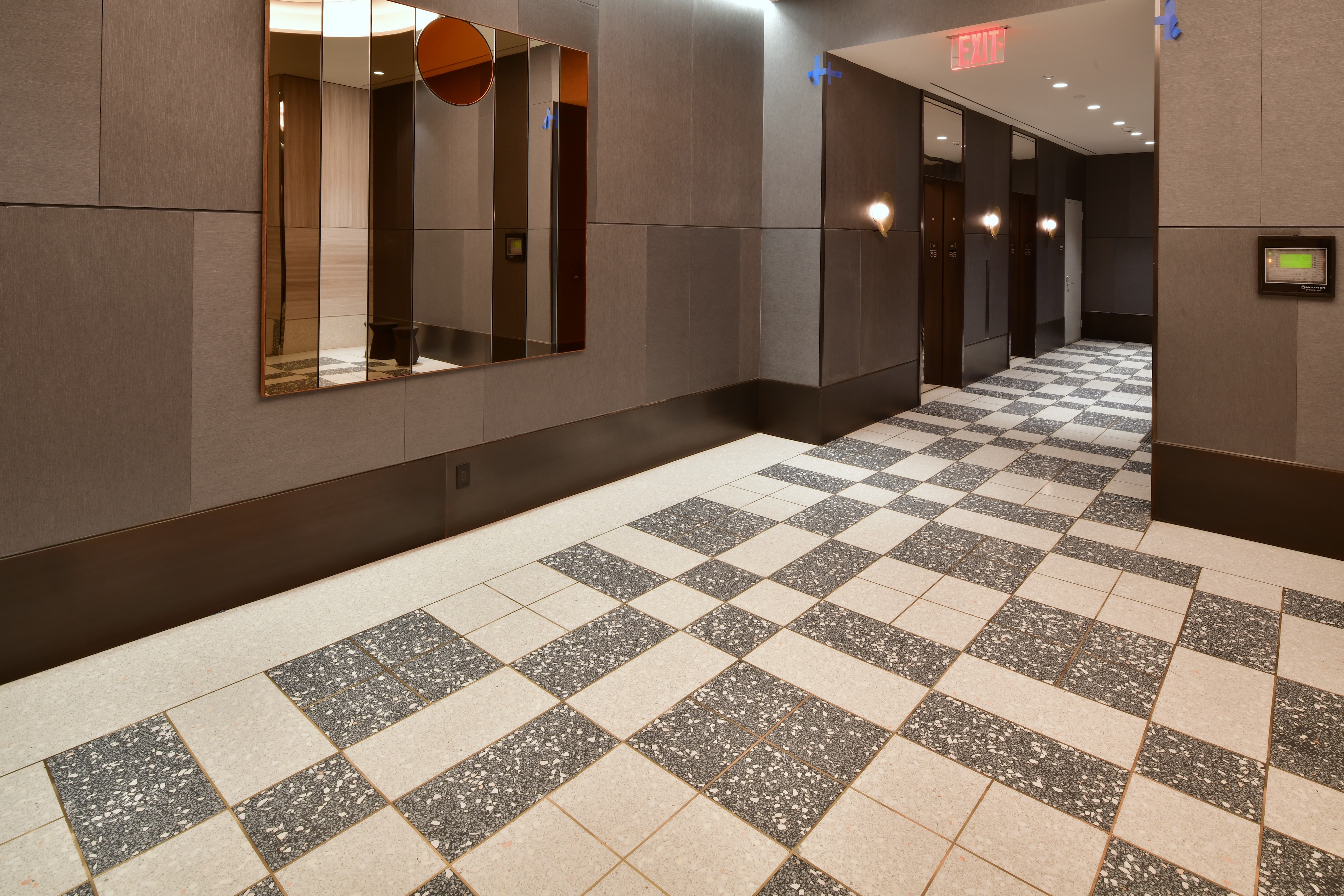
Structured checkerboard terrazzo pattern with pinwheeled brass divider strips continues into the elevator lobby, unifying the building’s public spaces.
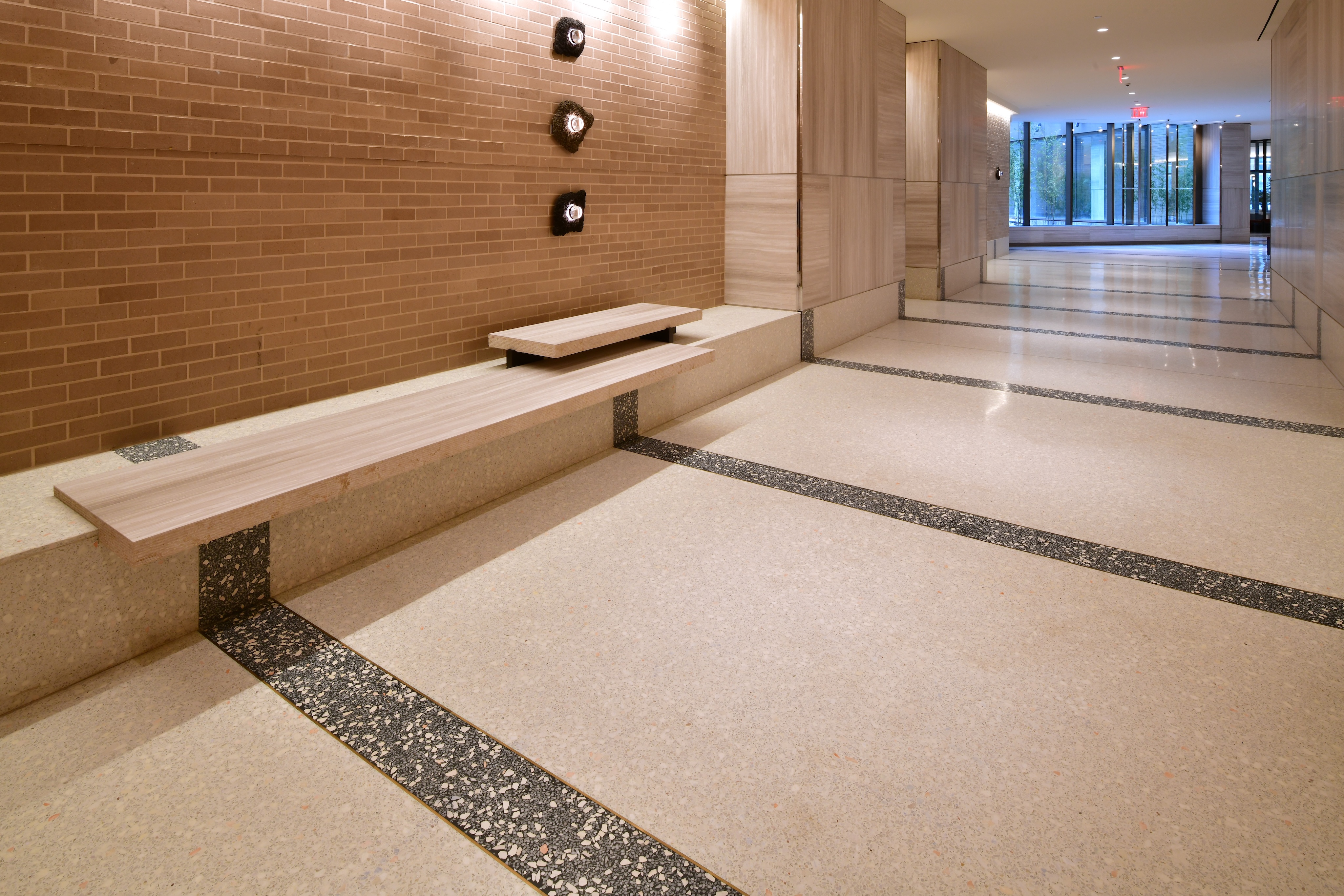
Built-in terrazzo benches extend the composition with charcoal bands continuing vertically. The installation is in a new residential development in Queens.

Pinwheeled brass strip composition and oversized marble aggregates define the public spaces of a residential tower on a reclaimed industrial site in Queens.
Project Site
Hunters Point sits on a reclaimed industrial waterfront in Long Island City, Queens. The mixed-use development, featuring ground-floor retail and a public park, is part of a broader transformation of the Hunters Point South neighborhood along the East River waterfront. The lobby terrazzo installation was central to establishing the building's architectural identity.
Design Concept
The floor draws on the Venetian terrazzo tradition: a composition defined by brass divider strips, marble aggregate, and a graphic two-color field. What reads at first glance as a playful, irregular checkerboard reveals on closer inspection a structured, repeating framework. The pattern animates the lobby and elevator corridors without overpowering the surrounding architecture.
The brass divider strips are laid in a pinwheel configuration, a classical arrangement that gives the composition directionality and visual energy. Corridor bands, introduced at a measured pace, lend contrast and cadence as visitors move through the space. Charcoal interrupts the cream field at regular intervals, a restrained palette that keeps the installation grounded while maintaining graphic clarity. Terrazzo extends beyond the floor into precast wall panels, carrying the material language of the lobby into the vertical plane and unifying the space.
Terrazzo Installation
The project involved over 4,000 linear feet of heavy-top quarter-inch brass divider strips set in a multicolor epoxy terrazzo system. Nearly 1,500 square feet of the installation consists of a pinwheeled brass strip layout in one-by-one and one-by-two-foot modules, with alternating poured-in-place terrazzo colors that replicate a tile composition.
The epoxy system was poured at five-eighths-inch—deeper than the standard three-eighths-inch—to accommodate the oversized marble aggregates that give the floor its depth and texture.
A significant technical challenge involved the interface between the terrazzo floor and the building's limestone wall panels. The majority of walls featured limestone meeting the terrazzo base with a reveal, a narrow gap that visually separates the terrazzo base from the limestone panels.
The detail required precise floor levelness to maintain a consistent reveal line from the top of the base to the stone panels. T. Yorie Corp. leveled the floors with epoxy fill to a tolerance of one-eighth inch in ten feet throughout the installation.
What It Accomplished
The finished installation gives Hunters Point North a lobby that is both formally resolved and materially durable. The Venetian composition is executed with the precision the tradition demands, in a building designed to serve its community for generations. This combination of disciplined layout, advanced epoxy techniques, and tight tolerances exemplifies the design achievement, craftsmanship, and technical execution recognized by the NTMA Honor Awards.
About T. Yorie Corp.
T. Yorie Corp. is headquartered in Allentown, Pennsylvania, with offices in Newark, New Jersey. The company began operations in 1976 and has been an NTMA member since 1987.
About the National Terrazzo & Mosaic Association
The annual NTMA Honor Awards recognize outstanding terrazzo installations completed by association member contractors. Entries are evaluated by design professionals and terrazzo specialists. A full list of this year's 17 Honor Award recipients is available at ntma.com.
Founded in 1923, the NTMA is a nonprofit trade association of over 150 contractor and supplier members, headquartered in Fredericksburg, Texas. The organization establishes national standards for all terrazzo systems and applications, advancing quality craftsmanship and innovation while supporting its members in the trade.
The NTMA provides a broad range of free resources for architects, designers, artists, contractors, maintenance professionals, and property owners. From assisting design teams with specifications to offering technical guidance throughout a project, the NTMA helps ensure terrazzo installations meet the highest standards. NTMA Technical Director Gary French is available at gary@ntma.com.
The association also offers AIA-registered continuing education programs for architects and design professionals. For more information about the NTMA Honor Awards and terrazzo resources for design professionals, visit ntma.com.
Terrazzo originated in 15th-century Italy, building on the mosaic traditions of ancient Rome. Venetian marble workers repurposed discarded stone chips into durable, decorative surfaces—a practice that made terrazzo an early sustainable material. Today, terrazzo is still poured by hand on-site, with options for precast panels and waterjet-cut details. Stone, recycled glass, or other aggregates—which may be locally sourced—are set in a cement or epoxy base, and the surface is then polished to reveal the aggregate's color and texture. Valued for its design versatility, ease of maintenance, durability, sustainability, and lifecycle value, terrazzo is built to last the life of a building.
Chad Rakow
National Terrazzo & Mosaic Assocation
+1 800-323-9736
info@ntma.com
Visit us on social media:
LinkedIn
Instagram
Facebook
YouTube
TikTok
National Terrazzo & Mosaic Association 2026 Honor Awards
Legal Disclaimer:
EIN Presswire provides this news content "as is" without warranty of any kind. We do not accept any responsibility or liability for the accuracy, content, images, videos, licenses, completeness, legality, or reliability of the information contained in this article. If you have any complaints or copyright issues related to this article, kindly contact the author above.
